
Good at your job but still not promoted? Learn how to build promotion

You deliver. Your manager rarely needs to follow up because you know your job, meet deadlines and consistently deliver good results.
Then a promotion opportunity comes up. And someone else gets it.
If your manager has ever passed you over for a promotion, you know how difficult that feels. After all, shouldn’t doing your job well help you progress?
Not necessarily.
Being good at your job matters. In fact, sustained performance is one of the strongest foundations for career progression. But there is an uncomfortable career truth that many people discover much later than they should:
Being excellent at your current job does not automatically show that you are ready for a bigger one.
When leaders decide whom to promote, they look beyond performance. They also assess readiness for the next role.
Being good at your job proves that you can succeed in your current role. To promote you, decision-makers need evidence that you can handle a bigger one. You can build that readiness deliberately.
Performance vs Promotion: They Answer Two Different Questions
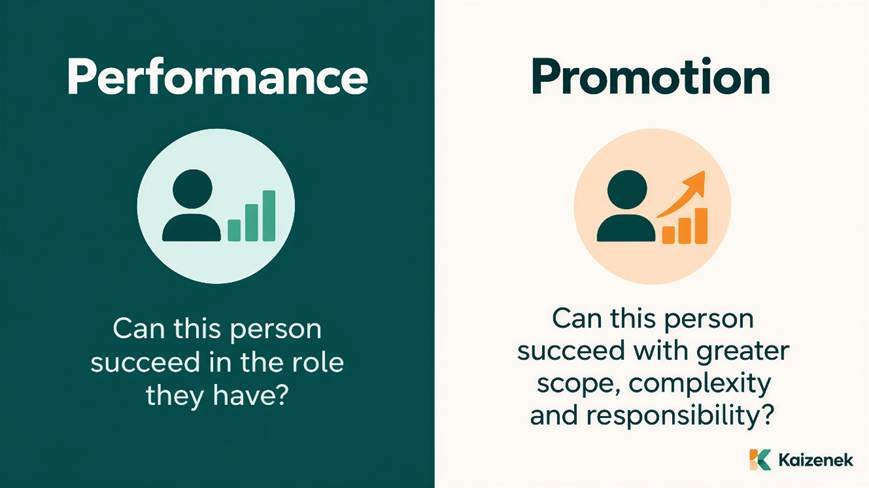
Strong performance tells an organization: Can this person succeed in the role they have?
A promotion requires the organization to consider a different question: Can this person succeed with greater scope, complexity and responsibility?
For example, imagine an exceptional salesperson who consistently exceeds targets. Product knowledge, customer insight and strong negotiation skills help them close business.
Promoting them into a sales management position changes the nature of the work.
Now they may need to coach underperformers, allocate territories, manage conflict, forecast performance, develop people, coordinate with other departments and make decisions affecting the entire team.
Those results show that they can sell. However, managing a sales team requires additional evidence.
The same principle applies across professions:
- The engineer becoming a team lead.
- The accountant becoming a finance manager.
- The HR specialist becoming a Head of HR.
- The designer becoming a creative director.
- The production supervisor becoming a plant manager.
At each transition, some capabilities remain important, while others become less central. Meanwhile, new responsibilities demand new skills.
A promotion is therefore not simply a reward for doing more of your current job. It is a decision to trust you with different and often more consequential work.
The Promotion Paradox: When Being Indispensable Holds You Back
Sometimes being exceptionally good at your job creates an unexpected problem. You become indispensable exactly where you are.
Because you know every process and solve every crisis, colleagues turn to you first. Your manager trusts you to fix whatever goes wrong.
That sounds like the perfect promotion case. But ask another question:
What happens when you leave the role?
If everything collapses without you, your value may be undeniable, but your readiness for greater responsibility may be less obvious than you think.
As responsibilities grow, organizations increasingly need people who can create capability beyond themselves. That means:
- Documenting processes.
- Developing others.
- Delegating.
- Sharing knowledge.
- Building systems.
- Creating continuity.
Eventually, producing results through your own effort creates a limit. By contrast, helping others produce results prepares you to operate at a different level.
That transition, from being the person who does everything to the person who enables more to happen, is one of the most important shifts in career growth.
Your Next Role May Require a Different Version of You
Every level of responsibility changes what good performance looks like.
Early in a career, employers may reward you primarily for execution.
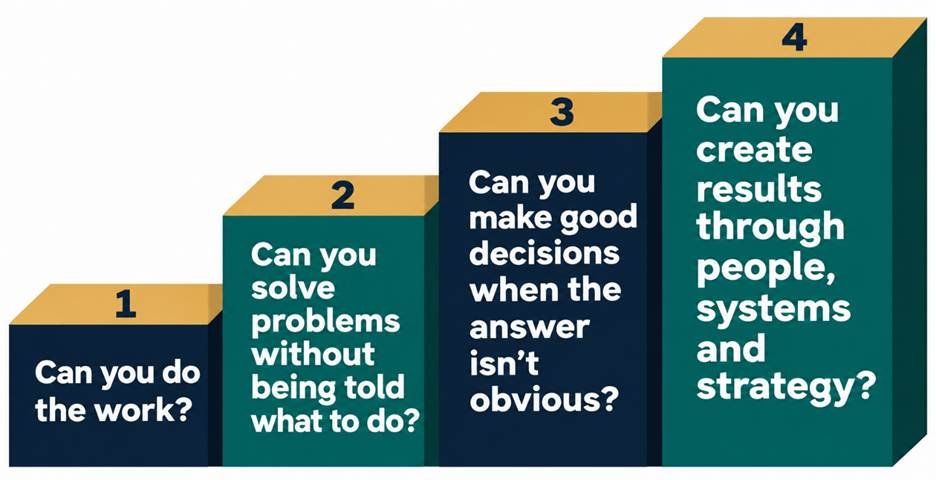
Can you do the work?
Later, the expectation becomes broader. Can you solve problems without being told exactly what to do?
Then: Can you make good decisions when the answer isn’t obvious?
And eventually: Can you create results through people, systems and strategy rather than through your own individual effort?
This is where many strong performers get stuck.
Often, they keep refining the skills that brought success at the previous level. They work faster, deepen their technical knowledge and personally handle more tasks.
But the next role may require almost the opposite:
- Make time to think, rather than filling every hour with tasks.
- Delegate decisions and support others as they learn.
- Take responsibility for team outcomes as well as individual output.
Career progression often requires you to change how you create value, not simply increase how much value you create.
Visibility at Work Matters, But Not in the Way You Think
“Your work should speak for itself.” It is a comforting idea.
Unfortunately, work rarely speaks. People do.
This does not mean you need to become the loudest person in the room, constantly advertise your achievements or turn every accomplishment into a personal marketing campaign.
It means that the people making promotion decisions need enough information to understand your contribution.
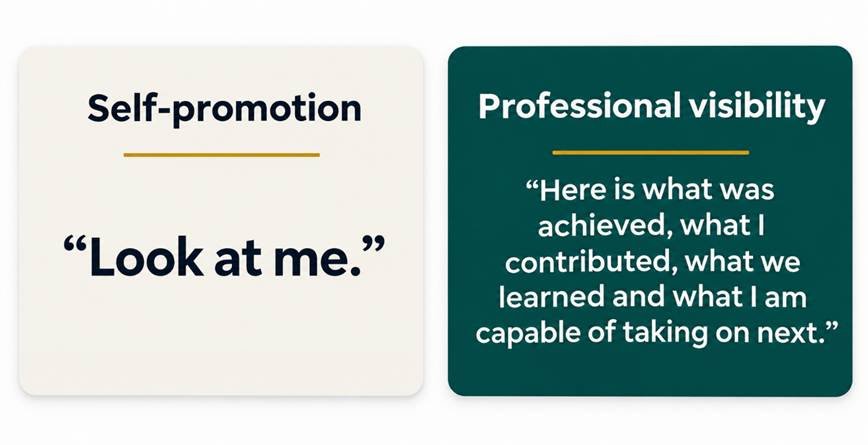
There is a difference between self-promotion and professional visibility.
Self-promotion says: Look at me.
Professional visibility says: Here is what we achieved, what I contributed, what we learned and what I am capable of taking on next.
You can create visibility at work by:
- Presenting your work.
- Participating meaningfully in cross-functional discussions.
- Communicating results clearly.
- Taking ownership of important projects.
- Making sure your manager understands both your contribution and your career aspirations.
Quiet competence creates value. However, decision-makers need to understand that value before they can recognize your readiness.
Your Manager Needs to Know You Want to Grow
Another surprisingly common career mistake is assuming that managers know what you want. They may not.
For example, your manager may recognize your strong performance without knowing that you want to lead a team.
Even when your ambition seems clear, your preferred career direction may not.
As a result, they may assume you are happy where you are.
Operational demands can also crowd out career discussions unless you start the conversation.
Start discussing your career before the organization announces a vacancy, so you have time to prepare.
Ask: What would I need to demonstrate for you to consider me ready for the next level?
That question is far more useful than: When will I be promoted?
The first invites clarity. The second often invites speculation.
Once you understand the expectations, you can deliberately build evidence of readiness.
Potential Needs Evidence: How to Show You Are Ready for Promotion
Organizations often talk about “potential.” But potential is difficult to evaluate when it exists only as possibility.
If you want greater responsibility, look for opportunities to demonstrate parts of that responsibility before the promotion arrives.
- To prepare for people management, start mentoring someone.
- For greater strategic exposure, ask to join planning discussions or a cross-functional initiative.
- Build your project management experience by taking ownership of a suitable project.
- If you want commercial responsibility, learn how your function affects revenue, cost, customers and operations.
- For senior leadership, practice thinking beyond your department.
You do not need to take on an entire job before the organization appoints you. However, decision-makers need evidence that you can grow into it.
Build your promotion case over the months before the conversation. That way, you can discuss examples of readiness rather than rely on promises.
Your Reputation at Work Is Already Speaking
Every workplace develops informal descriptions of people.
- Reliable.
- Brilliant technically.
- Great with clients.
- Difficult to work with.
- Gets things done.
- Needs constant supervision.
- Excellent under pressure.
- Doesn’t communicate.
- Strong with people.
- Avoids accountability.
- Commercially sharp.
- Not ready yet.
Although you may never hear these descriptions directly, they influence opportunities.
Your professional reputation is essentially the pattern people have observed in your behaviour over time.
In practice, you build your promotion case in ordinary moments:
- Your response when something goes wrong.
- The responsibility you take for mistakes and outcomes.
- Your treatment of people who cannot advance your career.
- Early communication when a deadline is at risk.
- The way you handle disagreement.
- Sound judgement that earns trust.
- Support that helps your manager move work forward.
Colleagues notice technical performance, but they also remember how you work.
Being Easy to Work With Is a Career Skill
This does not mean becoming agreeable, avoiding difficult conversations or saying yes to everything.
Senior roles often require exactly the opposite. You may need to challenge assumptions, give uncomfortable feedback, defend standards and make unpopular decisions.
But there is a difference between being willing to create necessary tension and simply being difficult.
As responsibilities increase, work becomes increasingly interdependent.
- Cooperation with people you do not manage.
- Influence with peers.
- Negotiation across competing priorities.
- Clear communication with people who see things differently.
Someone can be technically exceptional and still struggle to get promoted because working with them consistently creates unnecessary friction.
How you work with people becomes increasingly important as your career grows.
Understand the Business, Not Just Your Job
One of the clearest shifts between strong performers and people ready for broader responsibility is perspective.
Strong performers understand their work, while people preparing for larger roles also learn how the wider organization operates.
For example, they look at the decisions, constraints and relationships that shape their results.
They ask different questions:
- How does our organization make money?
- Which costs have the greatest effect on our results?
- Which outcomes matter most to our customers?
- Where do operational constraints slow us down?
- Which priorities need leadership’s attention?
- How does my department affect other departments?
- Which trade-offs must leaders make?
- Why did leadership choose this approach, even though it creates difficulties for my team?
The higher you move in an organization, the less useful it becomes to see the business only through the lens of your function.
For example, senior HR, finance and operations leaders all need to understand how their decisions affect the wider business.
Greater responsibility requires broader perspective.
You begin moving from: “How do I do my job well?”
to: “How does my work help the organization succeed?”
That is a significant career shift.
Sometimes, Not Getting Promoted Really Isn’t About You
There is another side to promotion that deserves acknowledgement.
Even if you prepare well, the organization may not offer you a promotion.
- No suitable vacancy may exist.
- The organization may be restructuring.
- The business may have limited funds.
- Someone else may have experience that is more relevant to the role.
- The company may prefer an external candidate.
- Your manager may not have authority over the decision.
- Organizational politics may influence the process.
Sometimes, leaders also handle promotion processes poorly.
Therefore, a disappointing career outcome does not automatically mean that you failed.
This is why career development should never depend entirely on one organization’s promotion decisions.
Your responsibility is to continue building your capability, experience, relationships, reputation and options.
An organization controls its positions. You are responsible for building your career.
Those are related, but they are not the same thing.
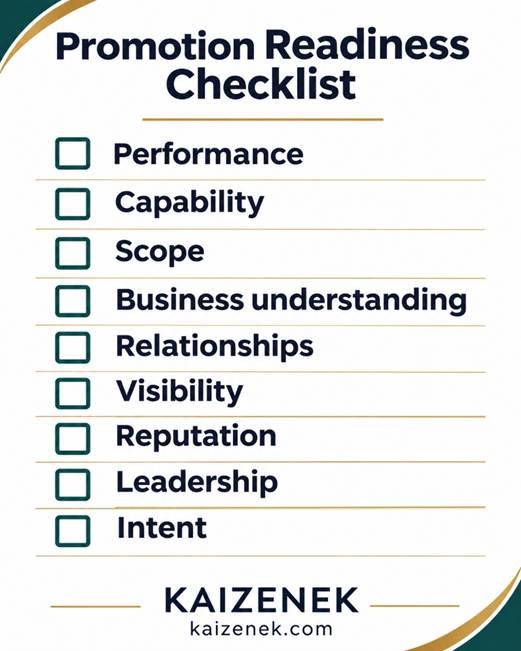
Promotion Readiness Checklist: 9 Questions to Ask Yourself
If you want to get promoted, start preparing before the next vacancy. Use these questions to identify the evidence you already have and the gaps to address.
Ask yourself:
- Performance: Am I consistently delivering what my current role requires?
- Capability: What skills does the next level require that my current role does not?
- Scope: Have I demonstrated that I can handle responsibility beyond my immediate tasks?
- Business understanding: Do I understand how my work connects to wider organizational priorities?
- Relationships: Can I work effectively across teams, levels and competing interests?
- Visibility: Do the right people understand the value and impact of my work?
- Reputation: What do people trust me to handle?
- Leadership: Am I creating capability around me or simply becoming indispensable myself?
- Intent: Have I clearly communicated where I want to grow?
Then comes perhaps the most important question: What evidence exists today that I am ready for more?
Look beyond what you believe you could do or would do if someone gave you the chance.
What have you already begun demonstrating?
That is where readiness becomes visible.
Don’t Just Perform. Prepare.
Being good at your job is not wasted effort simply because it does not immediately produce a promotion.
Strong performance creates credibility and trust. In turn, that trust can give you access to responsibilities through which you demonstrate readiness.
But career progression requires something more than repeatedly proving that you can succeed where you already are.
Instead, begin developing the capabilities that your next role requires.
So continue doing your job well. Become exceptional at the things that matter.
- Look beyond your task list.
- Understand the business.
- Develop other people.
- Take on harder problems.
- Build relationships.
- Communicate your impact.
- Strengthen your judgement.
- Seek exposure.
As you gain experience, demonstrate that you can carry greater responsibility before the title arrives.
Because the strongest case for promotion is not: “I’ve done this job well for long enough.”
It is: “I have grown beyond what this role originally required, and there is evidence that I am ready to contribute at a greater level.”
If you have been performing well but feel your career has stalled, ask yourself: Am I becoming better at my current job, or am I becoming ready for my next level of responsibility?
Those are not always the same journey.
Understanding the difference can change how you approach your career.
Ready to build your case for the next level?
Start with the skills that will help you take on greater responsibility. Explore Kaizenek’s courses and choose your next step.
Frequently Asked Questions About Getting Promoted
Why am I not getting promoted even though I am good at my job?
Strong performance shows that you can succeed in your current role. However, leaders also need evidence that you can handle greater scope, complexity and responsibility. Without that evidence, they may hesitate to promote you.
What is the difference between performance and promotion readiness?
Performance is how well you deliver what your current role requires. Readiness is the evidence that you can handle what the next role requires, such as developing other people, making good decisions and understanding the wider business.
How do I show that I am ready for a promotion?
Start demonstrating parts of the next role before the promotion arrives. Mentor someone, take ownership of a project, contribute to cross-functional work and learn how your function affects revenue, cost and customers.
How do I talk to my manager about a promotion?
Start the conversation before a vacancy arises. Ask: “What would I need to demonstrate for you to consider me ready for the next level?” Then agree on practical opportunities to build that evidence.